
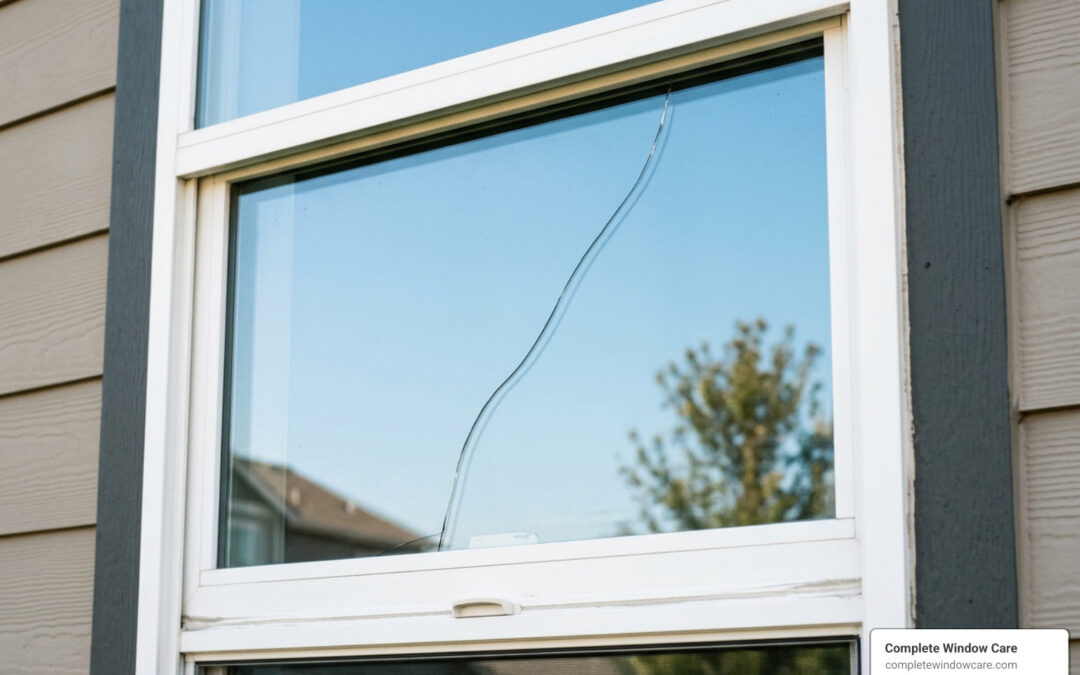
What Is a Stress Crack Window? Here is What to Know
A stress crack window is a crack in your glass that appears without anything hitting it. Here is what you need to know at a glance:
- What it is: A crack that starts near the edge of the glass and spreads inward, with no impact required
- What causes it: Uneven temperature across the glass surface, hidden edge damage, frame pressure, or home foundation settling
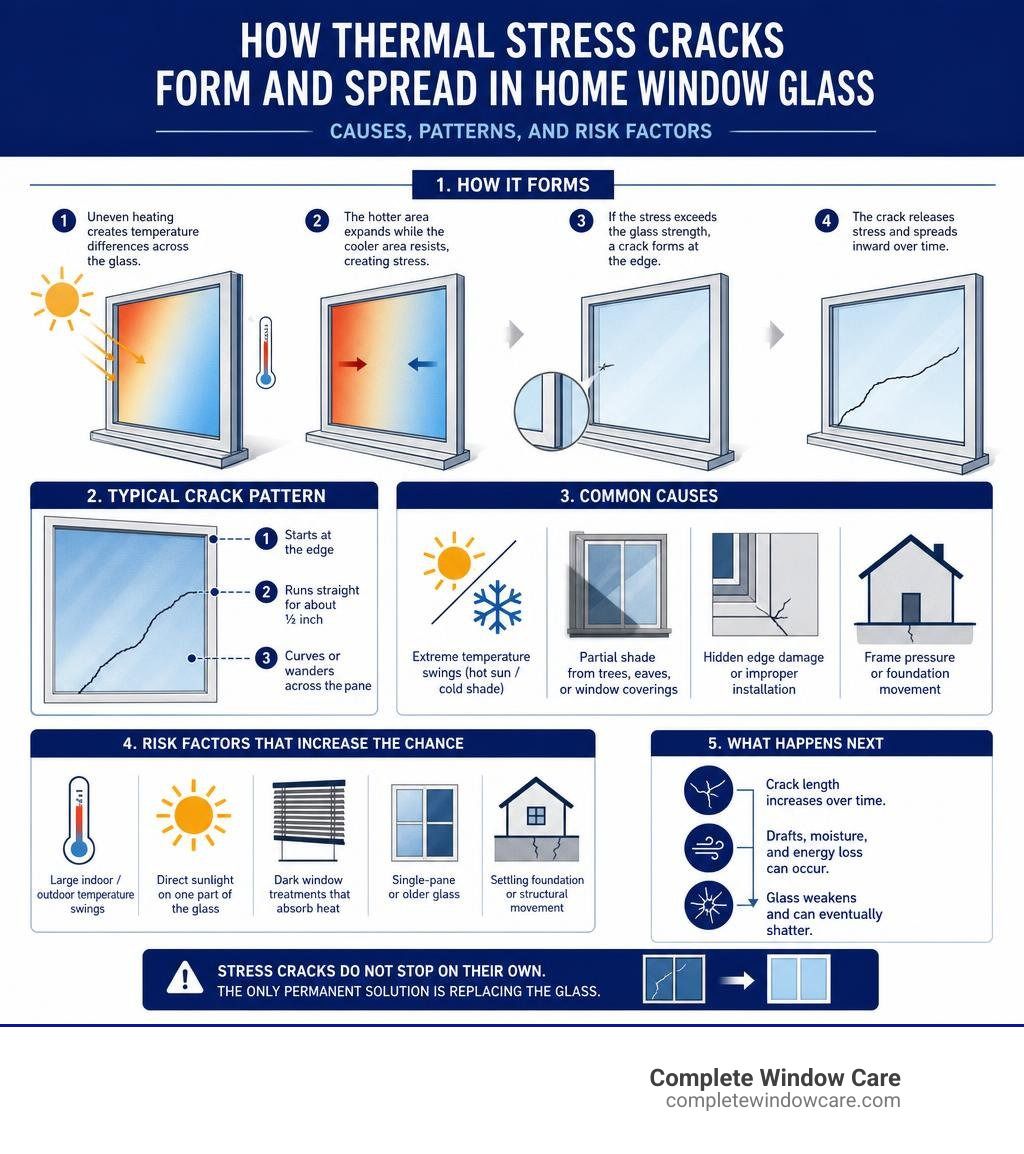
- How to spot it: Starts at the edge, runs straight for about half an inch, then curves or wanders across the pane
- Is it dangerous? Yes. It worsens over time, lets in drafts, and can eventually shatter
- What to do: Replace the glass. Stress cracks cannot be permanently repaired
You notice a crack snaking across your window. You did not hear a bang. Nobody threw anything. Nothing hit the glass. Yet there it is, a clean, curved line spreading from the edge of the pane toward the center.
That is a stress crack. And it is more common than most homeowners realize, especially here in Colorado Springs, where dramatic temperature swings between morning and afternoon are part of daily life.
Stress cracks do not always look alarming at first. But they do not stop on their own. Left alone, even a small crack will continue to spread, weakening the glass, reducing your window’s insulating ability, and eventually becoming a safety hazard.
At Complete Window Care, our local team has spent years diagnosing and repairing stress crack window damage across Colorado Springs and the Front Range. This guide walks you through what to look for, why these cracks happen, and when glass replacement is the safest next step.
Understanding the Stress Crack Window: Definition and Primary Causes
A thermal stress crack occurs when different parts of a single glass pane expand at different rates due to uneven temperatures. Think of it like pouring boiling hot water into a cold glass dish straight from the freezer: the sudden thermal expansion gradient creates intense internal material tension until the glass snaps.
When sunlight bakes the middle of a window pane, that central area heats up quickly and expands. However, the edges of the glass, buried deep inside the window sash and frame, remain hidden from the sun and stay significantly cooler. As the hot center tries to push outward, it exerts severe tensile stress along the cold, unyielding edges. If that tensile stress exceeds the natural structural strength of the glass, a crack initiates at the weakest point along the perimeter edge and walks inward.
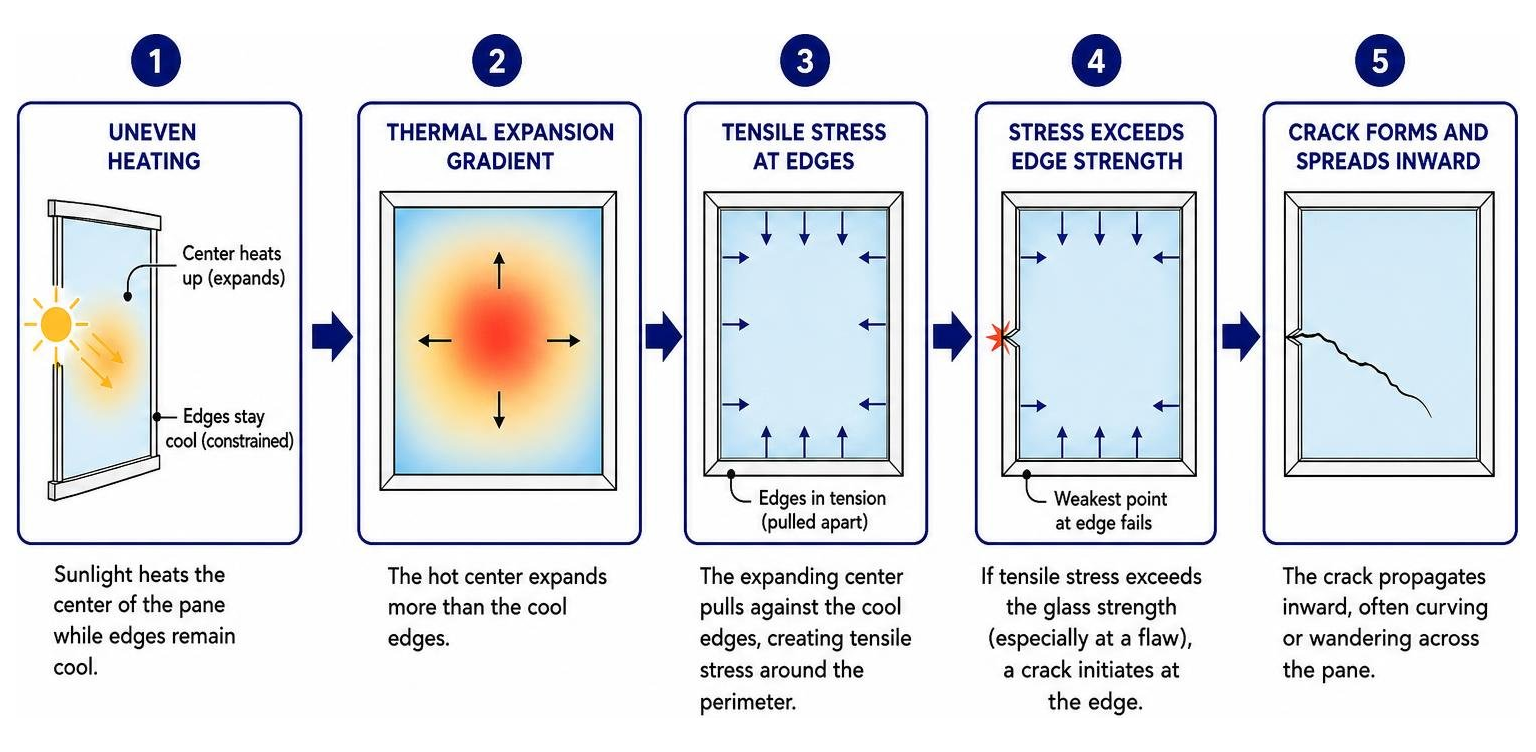
The structural integrity of the edge plays a massive role here. A clean-cut, undamaged glass edge provides maximum strength. However, microscopic chips, micro-cracks, or rough cutting from manufacturing or installation severely diminish edge strength. In fact, low-energy thermal fractures are by far the most common type of glass failure. They do not require extreme heat, just a minor temperature variance acting on pre-existing edge micro-damage.
Mechanical factors also trigger stress cracking. When a new home built in Colorado Springs settles during its first year, foundation movement can shift window openings by fractions of an inch. This transfers structural weight directly onto the window sash, squeezing the glass edges until they crack under the pressure. To learn more about how physical building dynamics impact your glass, our article on common residential window problems explains the warning signs Colorado Springs homeowners should not ignore.
Why Does a Stress Crack Window Form Without External Impact?
It can feel unsettling to wake up and discover a cracked window when nothing struck it. Spontaneous glass cracking occurs because thermal shocks and physical stress accumulate quietly over time until the glass reaches its breaking point.
Common indoor habits and sudden weather changes frequently trigger these cracks:
- HVAC and Interior Heat Placement: Placing space heaters, radiators, or heavy heating vents directly beneath a window forces intense heat onto the inner pane while the outer pane faces freezing Colorado winter air.
- Indoor Shading and Blinds: Closing thick thermal drapes or dark interior blinds tightly against solar control glass traps heat between the fabric and the pane, creating a severe heat-trap condition.
- Sudden Thermal Shocks: Extreme diurnal temperature shifts, such as a chilly 30°F morning in the Pikes Peak Region rapidly warming under intense, unclouded high-altitude sunlight, cause rapid expansion differential across the glass.
Window Types and Environmental Factors Most Susceptible to Cracking
Not all windows face the same level of thermal risk. Architectural design, glass coatings, frame materials, and immediate outdoor surroundings heavily influence vulnerability.
- Large Picture Windows: Expansive glass panes capture high levels of solar radiation, resulting in substantial expansion forces across the center of the unit.
- Partial Shadowing and Architectural Overhangs: Windows partially shaded by roof eaves, balconies, or protruding building sections experience stark heat contrast. One half bakes in bright sunlight while the other half stays cold in static shadow.
- Environmental Changes: Removing a shade tree in your yard or new neighboring construction can suddenly expose glass to direct sunlight for the first time in years, triggering thermal stress.
- Solar Control and Low-E Glass: High-absorption glass tints and energy-efficient coatings absorb considerable heat. While great for energy performance, they run hot in full sun, increasing thermal expansion differentials.
- Frame Insulation and Materials: Surprisingly, light-colored insulating frames made of vinyl or timber keep the covered glass edges cooler than dark conductive aluminum frames, actually widening the thermal gradient between edge and center.
- Wired and Textured Glass: The mechanical cutting process for wired glass creates inherently weaker edges compared to smooth float glass, lowering its resistance to thermal shock.
Identifying Stress Cracks vs. Impact and Pressure Cracks
Correctly identifying the type of crack in your window is critical for choosing the right solution and determining whether manufacturing warranties or home insurance apply.
| Crack Type | Primary Cause | Typical Visual Pattern | Origin Point |
|---|---|---|---|
| Thermal stress crack | Uneven expansion from solar heat or thermal shock | Starts perpendicular to edge, runs straight about 0.5 inches, then wanders or curves | Always originates at the hidden edge of the pane |
| Impact crack | Physical force from a rock, baseball, hail, or other object | Starburst or spiderweb pattern with radiating spider lines | Centered directly on the point of physical impact |
| Pressure crack | Atmospheric pressure shifts, altitude changes, or structural frame squeezing | Hourglass or sweeping arc curves spanning across the glass | Begins near edges or corners under heavy frame pressure |
Key Visual Characteristics of Thermal Stress Cracks
A stress crack window has distinct visual signatures that set it apart from physical damage:
- Perpendicular edge origin: The fracture almost always begins at the extreme edge of the glass pane beneath the framing sash.
- The 0.5-inch straight run: From the edge, the crack travels perfectly perpendicular, or 90 degrees, to the frame for about a half-inch before altering its path.
- Single, wandering line: Unlike shatter patterns, a thermal crack usually travels as a single, smooth, clean fracture line that gently curves or meanders across the window.
- Single-pane failure in double-pane units: In standard double-pane insulated glass units (IGUs), thermal stress cracks typically affect only one pane, usually the outer pane absorbing solar rays or the inner pane facing localized indoor heat.
How Impact and Atmospheric Pressure Cracks Differ
Impact cracks are immediately recognizable by their central point of origin. When an object strikes glass, energy disperses outward in a starburst pattern, leaving small crushed glass fragments or micro-shatters right at the impact zone.
Pressure cracks, on the other hand, stem from severe atmospheric pressure shifts or extreme elevation variances. For instance, when insulated glass units manufactured at sea level are transported up to the higher elevation of Colorado Springs without pressure-equalizing capillary tubes, the sealed air between the panes expands outward. This creates curved, sweeping, or hourglass-shaped fractures that look distinctly different from simple straight-edged thermal cracks.
Risks of Untreated Cracks and Preventative Solutions
Ignoring a stress crack because it looks small or harmless is a mistake. Window glass under continuous daily expansion and contraction will not self-heal.
Leaving a stress crack untreated creates several compounding problems:
- Progressive structural failure: Daily temperature cycles continuously force the crack to walk further across the glass pane until structural integrity is entirely lost.
- Loss of insulating gas and thermal efficiency: A crack fractures the hermetic seal of double-pane insulated glass, allowing insulating argon gas to leak out and letting ambient outdoor air in.
- Moisture intrusion and fogging: Once breached, outdoor humidity enters the space between the glass panes, causing permanent internal condensation, cloudiness, and mold growth. If the glass starts to haze or fog after cracking, this breakdown may look similar to the signs of a broken window seal.
- Safety and shatter risks: Weakened glass can shatter unexpectedly during strong Colorado hail storms or high wind events, posing serious safety risks to children and pets inside.
Actionable Ways to Prevent Thermal Glass Stress
While you cannot control the outdoor sun, strategic steps significantly lower the risk of thermal fractures:
- Specify tempered or heat-strengthened glass: Fully tempered glass undergoes extreme thermal processing, making it up to four times stronger than standard float glass and essentially immune to normal thermal stress.
- Ensure quality edge processing: Always work with reputable suppliers who polish or clean-cut glass edges to eliminate micro-chips before assembly.
- Maintain HVAC airflow deflection: Ensure indoor heating vents and portable space heaters point away from window panes to prevent localized thermal shocks.
- Choose exterior shading wisely: Utilize exterior awnings or retractable shades rather than tight indoor blackout blinds, allowing solar heat to reflect before penetrating the glass assembly.
Solutions for Broken Glass: Repair, Replacement, and Warranties
A common misconception among homeowners is that a cracked window pane can be patched with clear resin or glue, similar to a car windshield chip. Residential window glass is engineered differently, especially double-pane insulated units. Once a stress crack forms across standard window glass, the structural tension is permanently compromised and the sealed glass unit must be replaced.
Fortunately, fixing a stress crack window does not mean you have to tear out your entire window frame or ruin your home’s exterior trim.
How to Resolve a Stress Crack Window: Repair vs. Glass Replacement
When dealing with a stress-cracked window pane, homeowners generally face three choices:
- Clear resin or tape, temporary only: DIY resin kits or clear tape can temporarily hold loose glass together for safety, but they do not restore structural strength, regain insulating R-value, or stop moisture intrusion.
- Glass-only unit replacement, the smart, cost-effective choice: A certified technician leaves your existing window frame and sash intact, removing only the broken insulated glass unit (IGU) and installing a factory-sealed custom glass unit. This keeps the original frame in place while restoring full thermal performance. For homeowners comparing repair options, our guide to glass-only replacement vs. whole window replacement explains why replacing just the glass often makes more sense than replacing the entire window.
- Full window replacement: Replacing the frame, sash, and trim is rarely necessary unless the surrounding frame is deeply rotted, severely warped, or structurally collapsed.
If the cracked unit needs professional attention, Complete Window Care can inspect the pane, confirm whether the frame is still sound, and recommend the right window repair option for the home without pushing a full replacement when glass-only service will do. Homeowners who are unsure whether the damage calls for repair or replacement can also use the team’s window glass replacement service to get a practical, service-focused recommendation.
Are Stress Cracks Covered Under Manufacturer Warranties?
Coverage for stress cracks varies widely across window manufacturers. Because stress cracks stem from environmental factors, temperature differentials, or building settling rather than material flaws alone, many manufacturers limit stress crack coverage to a one-year warranty period from the date of manufacture or installation.
Key warranty considerations include:
- Time limits: Most factory warranties cover spontaneous stress cracking only within the first 12 months after home construction or installation.
- Proof of no impact: Manufacturers inspect the crack origin. If any impact point, chip, or external scratch is detected, the claim will be denied as physical damage.
- Professional installation requirements: Improperly installed frames that pinch the glass often void glass manufacturer warranties, placing liability on the installer.
Frequently Asked Questions About Window Stress Cracks
Are stress cracks common in residential home windows?
High-energy thermal stress fractures on pristine glass are quite rare. However, low-energy thermal stress cracks, where minor, hidden edge damage combines with everyday morning heat, are relatively common in modern residential homes. Large picture windows facing east or west experience them most frequently due to direct solar exposure.
Why did only one pane of my double-pane window crack?
In double-pane windows, the outer and inner panes exist in completely different environments. The outer pane absorbs intense ultraviolet solar radiation and copes with cold wind, while the inner pane remains at indoor room temperature. Because these individual thermal loads create independent expansion stress, it is completely normal for only one pane in an IGU to fracture while the other stays untouched.
Should I tape or glue a stress crack temporarily?
Applying strong clear packing tape over a stress crack can temporarily prevent loose glass shards from slipping or rattling in the wind while you wait for a replacement unit. However, tape and glue are temporary holding measures. They cannot stop the crack from walking further across the pane, nor can they restore lost insulating gas or prevent moisture fogging.
Conclusion
Discovering a stress crack window can feel frustrating, but it does not have to cause ongoing stress. By recognizing how thermal gradients work, identifying the distinct straight-to-curved crack pattern, and acting promptly before moisture ruins your window frame, you can protect your home’s energy efficiency and comfort.
Replacing only the damaged glass pane rather than paying for full window replacement is the most practical, budget-friendly solution for restoring your home. At Complete Window Care, our local Colorado Springs team specializes in precise, cost-effective glass replacement that keeps your original frames perfectly intact.
If you suspect a stress crack in your glass, contact our professional window glass replacement technicians to keep your home safe, clear, and energy efficient.