
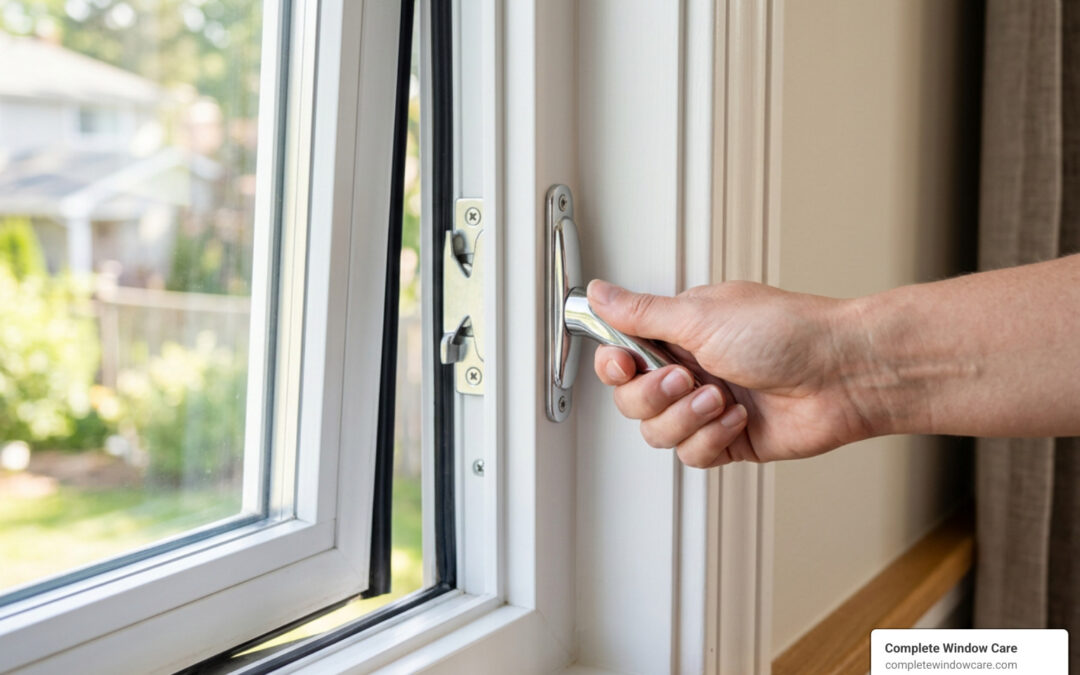
Fix a Broken Window Crank Before It Damages the Window
A window crank repair service can often restore a stuck, loose, noisy, or free-spinning window without replacing the entire window. Start by checking whether the handle turns but the sash does not move, the crank binds, or the window will not close and latch tightly. Do not force it: continued pressure can strip gears, bend the operator arms, or damage the sash.
In many cases, the fix is straightforward: tighten or replace a worn handle, clean and lubricate moving hardware, adjust a misaligned sash, or replace the crank operator. A professional should inspect the full mechanism when the window is hard to move, makes grinding sounds, will not seal, or has visible rust or broken arms.
A working crank matters beyond convenience. It helps the window close securely, compress weatherstripping correctly, reduce drafts, limit water intrusion, and lower avoidable security risks.
At Complete Window Care, our experienced team provides practical window crank repair service solutions across Colorado Springs and the Front Range. We focus on identifying the cause of the failure, restoring smooth operation, and helping homeowners avoid unnecessary full-window replacement.
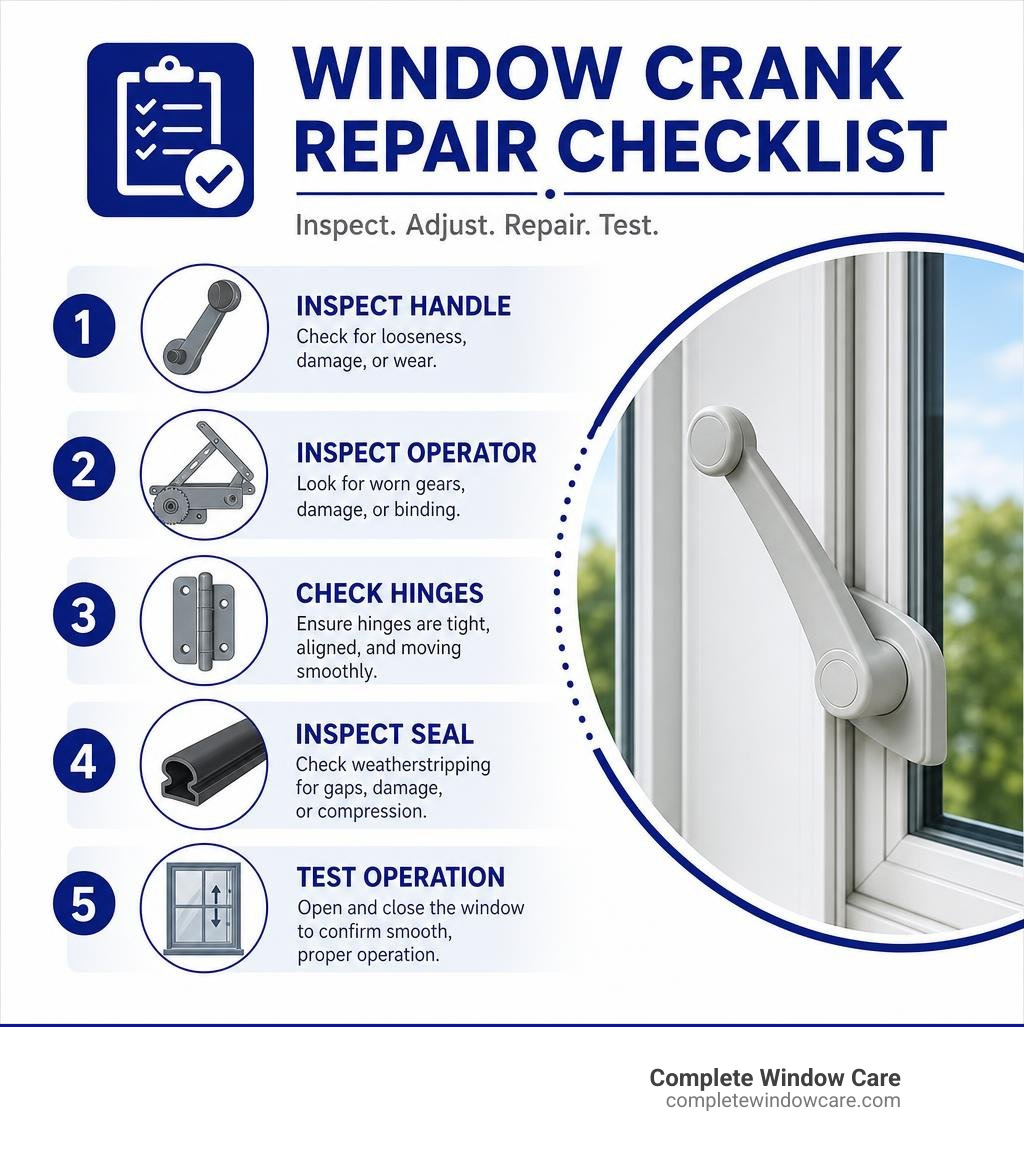
Understanding Window Crank Failure and Common Warning Signs
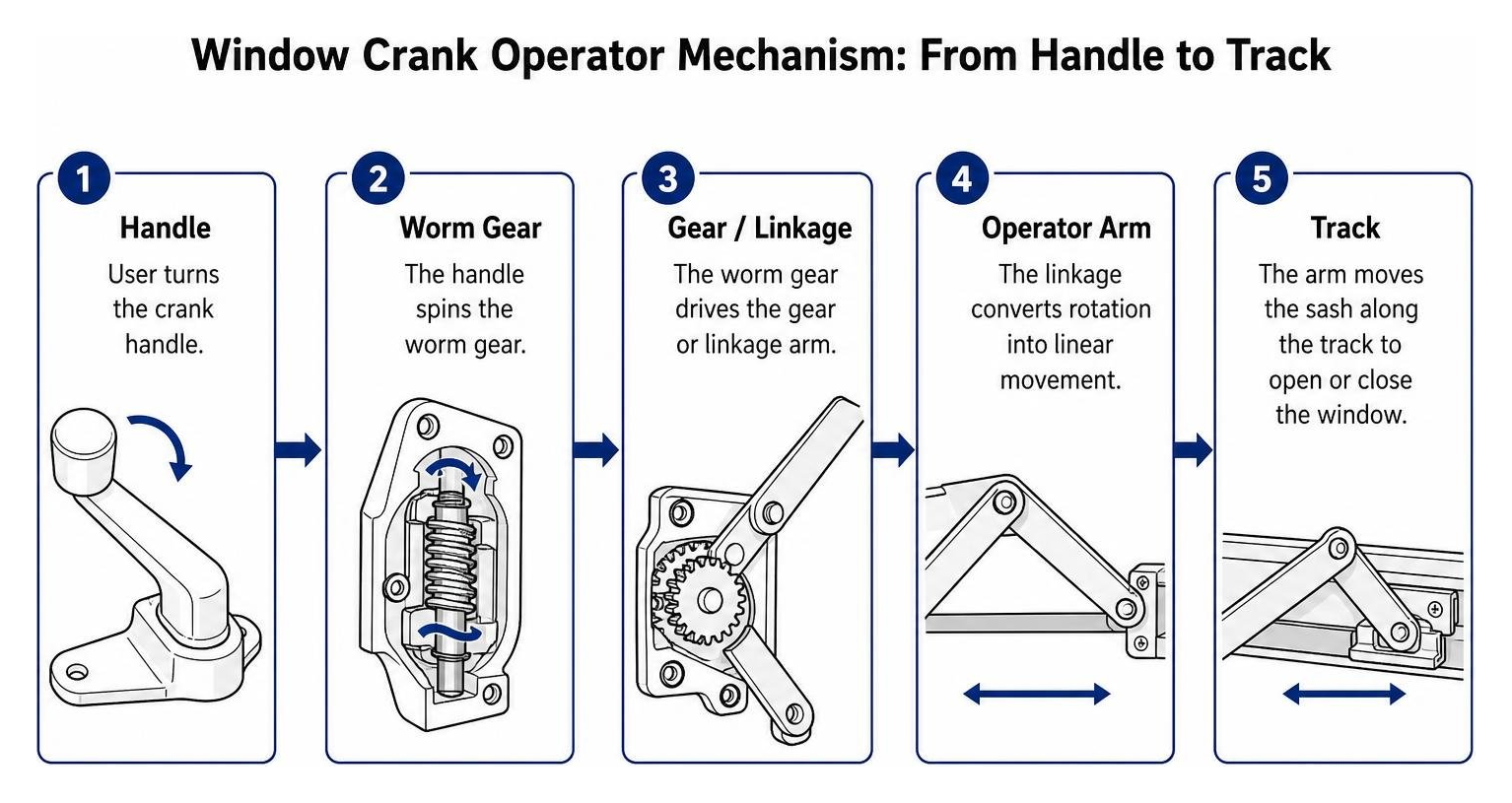
Window cranks, formally known as window operators, convert rotary motion into linear force to push heavy sashes open and pull them closed. Over time, physical stress, dirt accumulation, and fluctuating weather take their toll on these mechanical assemblies. When you understand the basic mechanics, diagnosing common window problems becomes far simpler.
A typical crank operator relies on an internal worm gear system. Turning the handle spins a threaded cylinder, which interlocks with a geared arm or a set of linkages. If any part of this chain binds or corrodes, mechanical resistance spikes. Continuing to force the handle past that resistance is what ultimately ruins the internal gears.
Signs You Need a Window Crank Repair Service
Recognizing early warning signs prevents minor gear wear from turning into an inoperable window or a compromised sash. If you experience any of the following symptoms, your window hardware requires attention:
- Free-spinning handle: You turn the crank, but the sash stays put. This usually indicates that the handle splines or the operator gears have stripped completely.
- Grinding or clicking noises: A noticeable crunch or pop during rotation points to broken teeth on the worm gear.
- Excessive resistance: The handle feels stiff or refuses to turn smoothly, signaling dried lubricant, rust buildup, or track obstructions.
- Sash misalignment: The window sash hangs crooked or fails to seat evenly into the frame when retracted.
- Air or moisture infiltration: The sash does not pull tight against the frame, leaving visible gaps where drafts and moisture enter your home.
Root Causes of Operator and Gear Failure
Window operators are engineered to handle normal operating loads, but specific environmental and human factors accelerate their failure:
- Stripped splines: The metal teeth inside the handle or on the operator spindle wear smooth after years of use or from loose set screws slipping under pressure.
- Worm gear deterioration: Forcing a stuck sash causes the hard steel worm gear to chew through softer metal gear teeth inside the operator housing.
- Operating against locked sashes: Attempting to crank an awning or casement window while the manual sash lock is still engaged places immediate, severe stress on the gear mechanism.
- Debris accumulation: Dust, pet hair, and airborne grit settle into the track and sill, creating friction that overworks the mechanical arms.
- Corrosion and lack of lubrication: Without periodic maintenance, factory grease dries up, allowing moisture to cause internal rust and binding.
Window Crank Types and Mechanism Repair Options
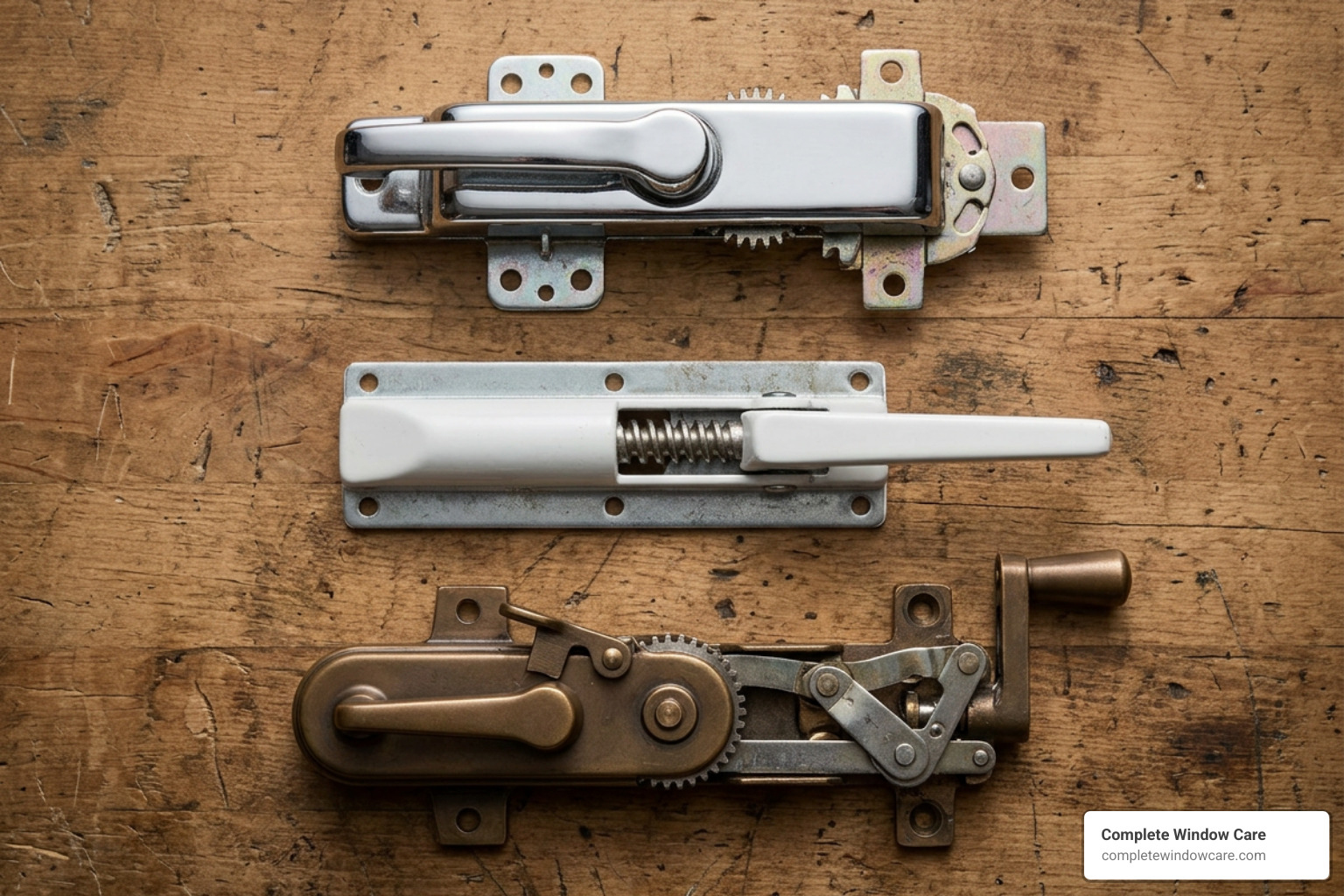
Window operators vary widely depending on the window style, manufacturer, and age of the home. Identifying the specific operator type is essential for selecting correct window parts and accessories during a repair.
Casement, Awning, and Specialty Window Operators
Different window designs use tailored mechanical linkages to support the weight and movement of the glass:
- Dual-arm casement operators: Common on wider casement units, these use a primary push arm combined with a secondary guide arm to maintain balance and stability across the entire swing path. Explore our casement window hardware options for compatible components.
- Single-arm operators: Standard on narrower casement windows, using one rigid arm with a roller attached to a track mounted on the bottom of the sash.
- Awning scissor operators: Designed for top-hinged windows, these operators feature dual scissor-action arms that push the bottom of the sash outward evenly.
- Butterfly and folding handles: Low-profile handle designs that fold flat against the sill when not in use, preventing interference with blinds, plantation shutters, or curtains.
- Jalousie and hopper mechanisms: Specialty multi-louver cranks or bottom-hinged pull operators that control specialized ventilation windows.
Handle Repair vs. Full Operator Replacement
Not every malfunctioning crank requires replacing the entire mechanical assembly. A key part of our diagnostic approach is determining whether a targeted handle fix or a full operator replacement provides the most reliable, cost-effective result.
If the internal gear housing is intact and the spindle turns freely using a pair of pliers, the issue is simply a stripped handle. Replacing the handle or securing a fresh set screw resolves the issue immediately. However, if the spindle wobbles, turns without resistance while the internal gears remain motionless, or the housing itself is cracked, the entire operator unit must be replaced.
Step-by-Step Window Crank Troubleshooting and Repair Process
Fixing a faulty window operator involves careful hardware extraction to protect the surrounding wood, vinyl, or drywall finishes.
Diagnostic Inspection and Hardware Assessment
- Clear the work area: Unlock the sash and remove any interior screens or window treatments that restrict access to the operator sill.
- Inspect the handle: Loosen the handle set screw with a flathead screwdriver, Phillips driver, or hex wrench. Pull the handle off the spindle and inspect both the male and female splines for stripping.
- Remove sill covers or trim: On many modern windows, a snap-on plastic or wooden trim plate conceals the operator body. Carefully pop this cover off using a non-marring pry tool to expose the mounting screws.
- Detach the linkage arms: Open the sash slightly to access the guide track. Slide the operator roller to the release notch on the track, or remove the retaining clip connecting the operator arm to the sash bracket.
- Inspect the hinges and track: Check the sash hinges for rust, bent guides, or debris before assuming the operator is the only failing component.
Precision Gear Adjustment, Lubrication, and Operator Replacement
- Extract the old operator: Back out the mounting screws securing the operator housing to the window sill. Lift the old unit out cleanly.
- Match replacement specifications: Compare the arm lengths, gear spindle diameter, screw hole patterns, and handedness, including left-hand or right-hand operation, to ensure an exact replacement fit.
- Install the new operator: Position the new mechanism onto the sill, aligning the screw holes with the original pilot holes. Fasten the mounting screws securely without over-torquing, which can crack vinyl or strip wooden frames.
- Reconnect sash linkages: Guide the operator arm roller back into the sash track. Reinstall any safety retaining clips.
- Clean and lubricate: Apply a dry silicone spray or lithium grease to the gears, pivot points, and slider tracks. Avoid petroleum-based lubricants that attract dust and grit.
- Reinstall trim and handle: Snap the sill cover back into position, slide the handle onto the spindle, and tighten the set screw firmly against the flat spot on the spindle.
- Test and verify operation: Cycle the window through several full open-and-close cycles. Confirm that the sash pulls completely flush into the frame and that the manual locks engage smoothly without resistance.
When to Call a Professional Window Crank Repair Service
While tightening a loose set screw is a manageable task, complex hardware failures warrant professional attention. Stripped casing screws, warped window frames, seized multi-point locking rods, or broken operators on high-reach windows present safety and performance challenges.
How to Select the Right Window Crank Repair Service
Choosing an experienced local specialist ensures your repairs are completed correctly the first time using durable, manufacturer-grade parts. When evaluating providers, keep these standards in mind:
- Specialized window hardware expertise: Ensure the technician specializes in hardware mechanics rather than pushing full window replacements. Homeowners comparing repair options can look for teams that explain which repairs are typically worth addressing before replacement.
- Transparent estimates: Look for upfront evaluations that clearly separate hardware needs from labor.
- Proper preparation and diagnostics: Reliable contractors explain how to prepare for a window repair appointment so the service proceeds efficiently.
- Workmanship guarantees: Reputable professionals stand behind their mechanical adjustments and replacement parts with clear warranties.
For Colorado Springs homeowners, related service needs often show up at the same time as crank problems. A sticking operator may be tied to worn window parts and accessories, while damaged frames, locks, or glass may call for broader window repair services. Addressing these issues together helps the window close securely and avoids repeated service visits.
Our blog resources can also help you decide what to fix first. If you are sorting out several symptoms at once, our guide to common window problems explains how small hardware issues can point to larger alignment or sealing concerns. Homeowners comparing local providers can also use our advice on choosing a window repair specialist before scheduling work.
Cost Breakdown: Repair vs. Window Replacement
Repairing or replacing a damaged operator mechanism usually costs far less than tearing out and replacing an entire window unit. Replacing a window often involves disturbing exterior siding, interior trim, and paint, which can be unnecessary when the frame, glass, and structural sash remain sound.
| Project Scope | Typical Hardware Involved | Primary Advantage |
|---|---|---|
| Handle replacement | Crank handle, set screw | Fast, lower-cost fix for stripped splines |
| Operator replacement | Worm gear assembly, dual/single arms, track roller | Fully restores original opening and closing action |
| Complete hardware overhaul | Operator, hinges, track, and sash lock | Extends total window lifespan by a decade or more |
| Full window tear-out | Complete frame, sash, glass, and exterior trim | Necessary only when frames are structurally rotted or warped |
Impact of Faulty Window Cranks on Security and Energy Efficiency
A malfunctioning window crank is more than an annoyance. It directly compromises your home’s thermal envelope and security. Casement and awning windows rely on the operator mechanism to pull the sash firmly against the perimeter weatherstripping.
When a crank mechanism slips or stops short of full closure, the weatherstripping cannot compress. This leaves small perimeter gaps that allow conditioned air to escape and outside drafts to enter, driving up seasonal heating and cooling demands. Improper closure also prevents sash locks from lining up with their keepers, undermining your window lock integrity and leaving your home vulnerable to forced entry. Restoring proper crank function ensures a tight thermal seal and dependable security every time you close your window.
Frequently Asked Questions About Window Crank Repair
How long does a typical window crank repair last?
A professionally installed, high-grade replacement operator generally lasts 10 to 15 years. Longevity depends heavily on proper installation, regular cleaning of the sash tracks, and avoiding forced operation against locked sashes or external obstructions.
Can a stripped window crank handle be repaired without replacing the mechanism?
Yes. If the internal worm gears inside the sill operator are intact and only the handle’s internal splines are rounded off, replacing the handle alone will fully restore function. Universal or manufacturer-specific replacement handles slide directly onto the existing spindle and secure tightly with a set screw.
How much does window crank repair typically cost?
Costs vary depending on whether the job requires a simple handle adjustment, a full dual-arm operator replacement, or addressing associated hinge and track damage. Repairing or replacing individual mechanical components is generally more cost-effective than replacing the complete window assembly.
Conclusion
A broken or binding window crank does not mean you need an expensive new window. Addressing gear wear, clearing track obstructions, and replacing worn operators restores smooth operation, eliminates drafts, and ensures your home remains secure.
At Complete Window Care, we specialize in practical, cost-effective solutions that keep your original windows working like new. If your casement or awning windows are sticking, grinding, or refusing to close tightly, contact our professional window crank repair technicians today.